11 Amazing Black Hole Facts for Kids [UPDATED]
 “Can a black hole swallow up our whole neighborhood like a giant vacuum cleaner?” That is usually the first wide-eyed question your kid asks right after hearing about outer space at school or bedtime.
Despite the spooky name, a black hole is not an empty pit in the sky at all, and it works in ways that sound more like a kitchen cartoon than a scary movie.
11 Interesting & Fun Black Hole Facts for Kids They Will Love to Know about
Most things in space shine brightly so you can spot them, from our warm daytime Sun to the twinkling stars above your roof. Black holes do the exact opposite by hiding in plain sight and bending the rules of how light, sound, and even clocks behave.
Once you break down how they work using everyday things like flashlights, spaghetti noodles, and piano keys, they become one of the coolest space topics you can share with your child.
Now let us take a look at those fun black hole facts!
1. Their Gravity Pulls So Hard That Not Even a Flashlight Beam Can Escape
When you switch on a flashlight in your backyard at night, that beam of light zooms across the yard faster than anything else in the universe. Light is so quick that nothing can outrun it in open space.
Around a black hole, the inward pull of gravity is so strong that even light gets trapped once it crosses an invisible outer boundary called the event horizon.
Because no light can escape that circle, the center stays completely pitch-black and invisible, casting a dark silhouette like a shadow during a lunar eclipse.
2. Black Holes Are Not Empty Holes at All, But Heavy Matter Squished Into a Tiny Spot
The word “hole” makes it sound like there is an empty pit floating up in space, just like a hole your kid digs in a backyard sandbox. It is easy to see why that name tricks almost everyone at first.
In real life, a black hole is not empty at all, because it packs a huge amount of heavy star material into an infinitely tiny center point called a singularity. Squished to that density, even Mount Everest would shrink smaller than a grain of sand.
Even when a star-sized black hole weighs tens of times more than our Sun, its outer boundary is only a few tens of kilometers across, which is about the width of one big city or a short car ride across town.
3. Messy Black Holes Spin Their Food Into a Glowing Ring Hotter Than the Sun
When gas and dust from a nearby star get pulled toward a black hole, all of that material cannot squeeze inside at the exact same moment.
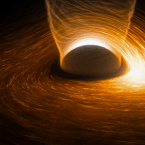
Just like cars backing up on a busy highway, the gas piles up outside the edge in a big traffic jam and spins fast into a flat ring called an accretion disk.
All that fast spinning heats the gas ring up to millions of degrees, making it shine brightly with X-rays while blowing leftover gas winds away at 20 million miles per hour.
4. New Black Holes Are Born in Seconds When Giant Stars Run Out of Fuel
For most of its life, a star stays puffed up like a giant round balloon because it burns hydrogen gas inside to push outward against the inward pull of gravity.
When a massive star with a collapsing core more than three times as massive as our Sun runs out of fuel, gravity crushes the star in a huge supernova explosion.
That inward collapse happens so fast that a brand-new black hole can form in just seconds, while a smaller star like our own Sun is too light to explode and will quietly become a white dwarf instead.
5. Getting Too Close Stretches Objects Out Like a Long Noodle of Spaghetti
Here on Earth, gravity pulls down on your head and your shoes with almost the exact same gentle strength. That steady pull lets you walk around in your normal shape every day.
If a spacecraft flew right up to a black hole, the gravity pulling on the front bumper would be way stronger than the gravity pulling on the back bumper due to tidal forces.
Scientists actually call this real stretching process spaghettification, because that uneven pull stretches a rocket or a passing star out thin like a long piece of kitchen spaghetti.
6. A Black Hole Pulls So Hard That It Can Slow Down Ticking Clocks
The clock hanging on your kitchen wall ticks at the exact same speed whether you are eating pancakes in the morning or brushing your teeth at night. On Earth, every second feels the same.
A black hole has such fierce gravity that it actually tugs on space and time itself, making time tick slower the closer you get to the edge. Physicist Albert Einstein showed that gravity bends time.
If an astronaut watched a friend drop toward a black hole from a safe distance, the falling friend would seem to move slower and slower, like someone pressing pause on a movie.
7. One Giant Black Hole Hums a Deep Musical Note Across Space
Most of outer space is too empty for sound waves to travel through, which makes it seem like black holes should be completely quiet. You normally need air or gas around you to carry a sound.
Inside the Perseus galaxy cluster, a giant black hole shoots out bursts of energy into surrounding gas clouds, sending acoustic waves rippling through space.
When scientists analyzed those waves, they found the black hole plays a real musical note, sitting 57 octaves below middle C on a regular piano, too deep for human ears.
8. A Supermassive Black Hole Named Sagittarius A* Lives in the Center of Our Galaxy
Nearly every big galaxy in the universe has a giant supermassive black hole sitting right in the middle of its starry neighborhood.
Our own Milky Way galaxy has one sitting at its center named Sagittarius A*, and it packs the heavy mass of 4 million Suns into one spot.
Even though a black hole of that size has an outer boundary spanning about 16 million miles across, our planet is completely safe because it sits more than 26,000 light-years away from Earth.
9. Around 100 Million Smaller Black Holes Hide Inside Our Milky Way Galaxy
Because black holes trap all light and look pitch-black against dark space, you cannot just look through a backyard telescope and count them like bright stars.
Scientists estimate that our Milky Way galaxy hides about 100 million smaller black holes that were left behind by giant stars that collapsed long ago.
To spot these invisible neighbors, astronomers play detective by watching how their strong gravity makes nearby stars speed up in their orbits, or by catching bursts of X-rays from hot gas spinning just outside them.
10. Black Holes Do Not Roam Around Sucking Up Everything Like Vacuum Containers
Cartoons and space movies love to show black holes acting like hungry floor vacuums that chase spaceships and suck up everything in sight. That movie trick makes a lot of kids worry about space.
In real life, black holes do not use suction at all the way a household vacuum cleaner does, and they can only pull in gas, dust, or stars that wander way too close. If our Sun were replaced, Earth would stay in orbit.
Even the biggest black holes in the middle of galaxies have a limited reach, which means a black hole can never eat an entire galaxy, and stars at a safe distance just keep orbiting peacefully.
11. Scientists Captured the First Picture of a Giant Black Hole Weighing 6.5 Billion Suns
For more than 200 years, scientists talked about the idea of black holes, and American physicist John Wheeler even gave them the name “black holes,” yet nobody had ever seen a real photo of one.
Because a black hole is completely dark, astronomers linked telescopes together to photograph the bright ring of hot gas bending around the dark shadow of a giant black hole in galaxy M87, like the dark circle during a solar eclipse.
That famous supermassive black hole sits 55 million light-years from Earth, spans 24 billion miles (38 billion kilometers) across, and weighs as much as 6.5 billion Suns.
Frequently Asked Questions (FAQs)
1. Are black holes actually empty holes in space?
No, black holes are not empty holes at all, because they are made of huge amounts of heavy matter packed tightly into a tiny space.
2. Will our Sun ever turn into a black hole?
No, our Sun will never become a black hole because a star must have a collapsing core more than three times as heavy as the Sun to collapse into one, so our Sun will quietly become a white dwarf instead.
3. What do black holes eat?
Black holes pull in nearby gas, dust, comets, planets, or stars that pass too close to their outer edge.
4. How big is a black hole?
A smaller star-sized black hole has an outer boundary only a few tens of kilometers across, while giant supermassive black holes at the centers of galaxies can span millions or billions of miles across.
5. Can a black hole suck up Earth or our whole galaxy?
No, black holes do not suck things in like vacuum cleaners, and their gravity reach is too limited to ever swallow up our galaxy or pull in Earth from far away.
6. Can black holes shrink over time?
Yes, physicist Stephen Hawking showed that black holes slowly leak tiny bits of energy called Hawking radiation, though it takes much longer than the 13.8-billion-year age of the universe for a regular black hole to evaporate.
Black holes might sound spooky at first, but once you know they are really just super-heavy retired stars that stay in their own lane, they are fun rather than frightening to talk about at bedtime. The next time you cook spaghetti for dinner or play a low note on a piano, your kid will have a great story to tell about how giant black holes behave out in space.
That was it, folks! Hope you and your little one enjoyed these amazing facts about black holes.