11 Surprising Earth Facts for Kids [UPDATED]
Stomp your feet on the sidewalk outside, and the ground feels completely still. Your kid might laugh out loud when you tell them that the yard, the house, and your whole neighborhood are actually spinning through space right now.
Even though you walk across this giant ball of rock and water every single day, your home planet hides some big surprises right under your shoes. You can share these fun discoveries with your child the next time you head outside for a walk.
11 Interesting & Fun Earth Facts for Kids They Will Love to Know about
Most planets across space are either freezing cold or way too hot for any plant or animal to survive. Your home planet is the one cozy spot in space with splashy blue oceans, fresh air to breathe, and a strong shield overhead.
From a super-hot metal center to a giant volcano hiding underwater, the world beneath your sneakers works in some very clever ways.
Now let us take a look at those fun Earth facts!
1. Earth Is the Only Planet Not Named After a God
Almost every planet in our solar system got its name from an old story about powerful Greek and Roman gods and goddesses. You might guess that your home planet was named after a famous sky god too.
Earth is actually the only planet in the solar system that was not named after a god or goddess. Instead of mythological characters, the name comes from an Old English and Germanic word that simply means “the ground” or “soil”.
People started calling our world by this simple name about 1,000 years ago because it describes the solid dirt and rock right under your feet.
2. Earth Would Be the Size of a Nickel Next to a Front-Door Sun
When you look at long highways, big parks, and tall buildings, our world feels gigantic. Out in space, Earth ranks as the fifth-largest planet in the solar system, and it is the number one largest rocky planet of all!
If you could measure straight through the middle of Earth from one side to the other, it is about 8,000 miles (12,742 kilometers) wide. That gives plenty of room for all our neighborhoods, mountains, and deep oceans.
Next to the Sun, however, our big planet looks tiny. If the Sun were as tall as a typical front door on your house, Earth would only be the size of a shiny nickel in your pocket!
3. Water Covers About 71 Percent of Earth’s Surface
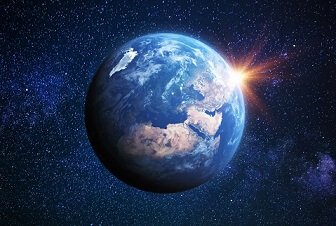
If you flew high up in a spaceship and looked back down, Earth would look like a bright blue marble with white cloud puffs. It looks mostly blue because water covers way more of the planet than dry dirt and rock do.
Liquid water covers about 71 percent of Earth’s surface, and almost all of it sits inside giant oceans. All the green forests, yellow deserts, and brown mountains where people live take up less than one-third of the planet.
Even though our planet has so much water, over 96 percent of it is salty ocean water, leaving only a tiny splash of fresh water in lakes, rivers, and rain for land animals to drink!
4. Earth Sits in the Cozy “Goldilocks” Spot From the Sun
In the fairy tale of Goldilocks and the Three Bears, Goldilocks wanted her bowl of porridge to be not too hot and not too cold. Scientists call Earth the “Goldilocks planet” for that exact same reason.
As the third planet from the Sun, Earth orbits at an average distance of about 93 million miles (150 million kilometers) away. That distance is the sweet spot where our world gets just the right amount of sunshine and warmth, with sunlight taking just 8 minutes and 20 seconds to reach our eyes!
If Earth sat much closer to the Sun, our oceans and puddles would quickly dry up into the air. If it sat much farther away, all that water would stay frozen solid like an ice cube.
5. Earth Is Slightly Squished Instead of a Perfect Ball
Classroom globes and space photos make Earth look like a smooth, perfectly round basketball. Even though people have known Earth is round for more than 2,000 years, it is actually not a perfect sphere.
Because Earth spins around every day like a toy top, the force of that spinning motion gently squishes the planet into a shape called an oblate spheroid. That spin makes the North and South Poles slightly flat while the equator around the middle bulges outward by about 27 miles (43 kilometers).
You can picture Earth like a soft bouncy ball that you press down on gently at the very top and bottom. Because of this middle bulge, standing on the equator actually places you about 13 miles farther from Earth’s center than standing at the North Pole!
6. A 23.5-Degree Sideways Tilt Gives You Four Seasons
Every single day, Earth makes one full spin every 24 hours, turning your yard toward the Sun for daytime and away from the Sun for nighttime. While it spins, our planet does not stand straight up and down.
Instead, Earth leans over to the side at an angle of 23.5 degrees. That gentle sideways lean is the true reason your weather changes throughout the year, not how close we are to the Sun!
During the part of the year when your half of Earth leans toward the Sun, you get more direct sunlight and warm summer days. Six months later, your half leans away from the Sun, bringing cooler winter weather.
7. Earth Takes an Extra Quarter of a Day to Circle the Sun
Your wall calendar at home counts exactly 365 days in one normal year. Earth actually takes a tiny bit longer than that to finish its big oval trip around the Sun.
It takes our planet 365.25 days to travel all the way around the Sun once. That means every single year leaves an extra quarter of a day (about six hours) left over at the end.
To solve this calendar puzzle, we bundle those extra hours together every four years and add one full bonus day to the calendar: February 29th, creating what we call a leap year!
8. Earth Wears an Air Blanket That Burns Up Space Rocks
Right above your head, Earth is wrapped in a thick blanket of air made of 78 percent nitrogen, 21 percent oxygen, and 1 percent other gases. This atmosphere has kept life safe for millions of years, protecting living creatures from ancient dinosaurs to people today.
Outer space is full of rocky chunks called meteoroids zooming toward our world at speeds over 30,000 miles per hour. Before most of those space rocks can ever touch the ground, Earth’s thick air blanket rubs against them and burns them away high in the sky.
When those bits of rock burn up high overhead, you can spot them flashing across the dark night sky as bright streaks called meteors (or shooting stars).
9. The Deep Center of Earth Is as Hot as 9,800 Degrees Fahrenheit
The grass and playground dirt under your shoes feel cool and solid. You are actually standing on a thin outer rocky shell called the crust, which goes about 19 miles (30 kilometers) deep on land and only 3 miles (5 kilometers) deep under the ocean floor.
Way down beneath that crust and a thick rocky middle layer, the deep center of Earth is scorching hot. Temperatures down in the solid inner core reach as high as 9,800 degrees Fahrenheit (5,400 degrees Celsius), which is about as hot as the surface of the Sun!
Wrapped around that inner core is a churning ocean of melted iron and nickel metal about 1,400 miles thick. The swirling flow of this liquid metal builds a giant magnetic shield around Earth that deflects dangerous space radiation.
10. Earth’s Single Moon Stops Our Planet From Wobbling Wildly
Earth is the only planet in our solar system that travels through space with just one moon. That bright neighbor in your night sky does a very important job for every living thing on the ground, sometimes passing directly through Earth’s shadow during a lunar eclipse.
As Earth spins around, it naturally wants to teeter like a spinning top. Our Moon’s steady gravity pulls on Earth and stabilizes our planet’s wobble, keeping our axial tilt steady so our climate stays calm over thousands of years.
Even though the Moon orbits at an average distance of 238,855 miles (384,400 kilometers) away, a gap wide enough to fit 30 Earth-sized planets side by side, its gravitational anchor keeps our world from tilting out of control like Mars!
11. Earth’s Tallest Mountain From Bottom to Top Hides Underwater
Almost everyone hears that Mount Everest is the tallest mountain in the world. Everest does have the highest peak above sea level, reaching 29,029 feet (8,848 meters) into the sky.
If you measure a mountain all the way from its deep ocean base to its top peak, a volcano in Hawaii named Mauna Kea is actually taller! Mauna Kea starts deep on the Pacific Ocean floor and rises more than 33,500 feet (10,210 meters) from base to peak.
Because more than 19,000 feet of Mauna Kea sits underwater like a tall swimmer standing in the deep end of a pool, only its snowy tip pokes above the waves while Everest stands tall on dry land.
Frequently Asked Questions (FAQs)
How old is planet Earth?
Scientists have discovered that Earth formed about 4.54 billion years ago when gravity pulled swirling gas and dust together around the young Sun.
How wide is Earth across the middle?
Earth is the fifth-largest planet in our solar system and measures about 8,000 miles (12,742 kilometers) wide across the middle.
How much of Earth is covered in water?
Liquid water covers about 71 percent of Earth’s surface (mostly inside oceans), while dry land makes up the remaining 29 percent.
Does Earth have any rings or extra moons?
Earth has zero rings and is the only planet in our solar system that has just one permanent moon.
What is the air around Earth made of?
Earth’s atmosphere is made of 78 percent nitrogen, 21 percent oxygen, and 1 percent other gases like argon and carbon dioxide.
How far is Earth from the Sun?
Earth orbits at an average distance of about 93 million miles (150 million kilometers) from the Sun as the third-closest planet.
The next time you and your child step outside to look at the clouds or the Moon, you can remind them that their feet are resting on a spinning blue marble with a super-hot metal center. Every breath of fresh air and every changing season is part of what makes our home planet so special.
That was it, folks! Hope you and your little one enjoyed these amazing facts about Earth.