
11 Amazing Ancient Egypt Facts for Kids [UPDATED Facts]
 Watching your child wrap themselves in a roll of toilet paper to pretend to be a spooky mummy is a classic living room game. But those fun homemade costumes actually connect to one of the most amazing places in history.
From giant stone pyramids built without a single crane to real rulers wearing solid gold masks, this desert kingdom is even better than a storybook. Sharing these true stories from thousands of years ago is the perfect way to turn everyday playtime into a fun history adventure.
11 Interesting & Fun Ancient Egypt Facts for Kids They Will Love to Know about
When you were a kid, you probably wondered what was hidden inside the giant pyramids or how people wrote secret messages using little pictures on stone walls. Life along the Nile River was full of clever inventions that you and your family still use every single day.
Everything from the paper on your kitchen table to the calendar hanging on your wall started with smart ideas from this ancient desert land.
Now let us take a look at those fun Ancient Egypt facts!
1. Ancient Egyptians Created the First 365-Day Calendar
When you look at a wall calendar in your kitchen, you can easily count the days until your next birthday. Thousands of years ago, people did not have a simple way to track a whole year from start to finish.
Beginning over 5,000 years ago, Egyptian astronomers looked up into outer space and tracked Sirius, the brightest star in the night sky. Whenever Sirius reappeared at dawn right before sunrise, farmers knew the Nile River was about to flood and bring rich soil to their fields!
Using the sun and Sirius, they invented the world’s first known 365-day calendar: 12 months of 30 days each, plus 5 extra festival days at the end of the year to celebrate their gods. Every time you flip a calendar page at home, you are using a clever invention created thousands of years ago in the desert.
2. The Great Pyramid of Giza Was Built with 2.3 Million Giant Stone Blocks
Stacking toy blocks on your living room floor is easy until your tower gets taller than your head. Imagine trying to stack giant heavy rocks in the hot desert without cranes, dump trucks, or metal pulleys.
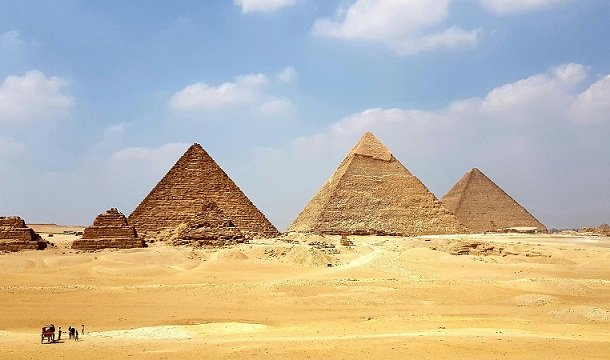
Workers stacked about 2.3 million stone blocks to build the Great Pyramid of Giza for Pharaoh Khufu. When finished, it stood an astounding 481 feet (147 meters) tall, making it the tallest human-made structure on Earth for over 3,800 years!
Most blocks weigh about 2.5 tons (as heavy as an SUV), while the massive granite ceiling slabs over the King’s Chamber weigh up to 80 tons each. To move these giants across the desert without modern engines, clever workers loaded stones onto heavy wooden sledges and poured water on the sand right in front, cutting the friction in half so the sledges could glide smoothly!
3. Paid Workers Built the Great Pyramids, Not Enslaved People
Many cartoons and movies show mean bosses forcing enslaved people to drag pyramid rocks in the hot sun. If you heard that story growing up, you might be surprised to learn that it is actually a myth.
Archaeologists discovered the actual Workers’ Village and cemetery right next to the pyramids, proving that paid, respected Egyptian citizens built them, not enslaved laborers! Building crews took immense national pride in their work, and when workers were injured, royal doctors gave them high-quality medical care, while families received rations of prime beef, bread, and beer.
In 2013, archaeologists unearthed the Diary of Merer at the Red Sea port of Wadi al-Jarf. This 4,500-year-old papyrus scroll was written by a real building inspector named Merer, describing how his 200-man team navigated cargo boats down the Nile to deliver gleaming white limestone to Khufu’s pyramid.
4. Mummy Makers Left the Heart Inside the Body on Purpose
You have probably seen mummies wrapped in white cloth in Halloween cartoons. In Ancient Egypt, making a real mummy for a king or rich person was a careful job that took about 70 days.
Mummy makers removed the lungs, stomach, liver, and intestines into four decorative canopic jars (one of which was protected by a sacred baboon god named Hapi!), but they deliberately left the heart inside the chest. Egyptians believed the heart was the center of memory and emotion, which the god Anubis would weigh against the delicate Feather of Truth in the afterlife.
To preserve the body safely, embalmers dried it for 40 days using a natural mineral salt called natron before rubbing it in fragrant oils and wrapping it in hundreds of yards of linen. Important mummies were placed inside nested coffins called sarcophagi, and King Tutankhamun had an innermost coffin crafted from over 240 pounds of solid gold!
5. Families Loved Cats So Much They Made Mouse Mummies for Cat Snacks
If you have a pet cat curled up on your couch, you already know that cats act like they rule the house. People in Ancient Egypt loved cats so much that they treated them as sacred animals.
Ancient Egyptians loved their feline friends so much they gave them the playful name Mau (which sounds just like a meow!). Cats started out as brave rodent hunters that protected grain barns from rats and venomous snakes, inspiring deep respect for the cat goddess Bastet and powerful feline predators like the lion.
When a beloved pet cat passed away, family members shaved off their own eyebrows as a sign of deep mourning. Archaeologists have uncovered thousands of cat mummies lovingly buried alongside tiny mouse mummies so the cherished pets would have snacks in the afterlife!
6. Both Men and Women Wore Green Eyeshadow and Black Eyeliner
Today, your kid might see grown-ups put on makeup before heading out to a party or work. In Ancient Egypt, wearing bold makeup every day was a normal routine for both men and women.
Men and women painted their eyelids with shimmering green malachite (a copper mineral) and traced thick black lines around their eyes with kohl (crushed galena mineral). Women also added red ochre to their lips and cheeks and dyed their nails with henna.
Wearing makeup was smart desert science, not just vanity! Just like modern athletes wear dark grease under their eyes, dark kohl absorbed the blinding desert sun glare and kept flies away. Scientists at the Louvre Museum even discovered that mineral compounds in Egyptian kohl stimulated immune cells to prevent painful eye infections from river water.
7. Families Built Mud-Brick Houses with Tiny High Windows to Stay Cool
Living in a sunny desert without air conditioning sounds super hot and sticky, but families used clever architecture to survive scorching summer days!
They shaped thick house walls from sun-baked mud bricks made of Nile silt and straw. These dense walls acted like giant heat sponges, absorbing the desert heat during the day and keeping the indoors cool. They built windows very small and high near the ceiling so trapped hot air could rise and escape without letting in the blinding sun or dust.
In the evening, when the desert air cooled down, families climbed up to eat, play, and sleep on their flat rooftops under the open stars!
8. They Made the First Paper Rolls from 15-Foot River Plants Called Papyrus
Every day at school, your child draws pictures on smooth white paper made from wood pulp. Long before tree paper existed, Egyptians invented writing sheets from a triangular marsh plant called papyrus! This tall green plant grew up to 15 feet (4.6 meters) tall in the shallow marshes of the Nile delta.
Workers sliced the spongy inner stalk into thin strips, laid two layers across each other at right angles, and hammered them flat. The plant’s natural sugary juices acted as a natural glue, fusing the fibers into a crisp, sturdy sheet without needing artificial paste! Our modern English word ‘paper’ comes directly from the word papyrus, and scribes pasted sheets together into long scrolls.
9. Carvers Wrote with Picture Symbols Called Hieroglyphics for Over 3,000 Years
When you send a text message with little picture emojis, your kid can guess what you mean right away. Ancient Egyptians had three writing systems, and their oldest and most famous one used hundreds of carved pictures.
Ancient Egyptians called their writing Medu Netjer, meaning “Words of the Gods,” while the Greeks called it hieroglyphics (“sacred carvings”). It featured over 700 symbols representing people, animals, tools, and water ripples! Some symbols represented whole words, while others stood for phonetic sounds just like modern letters.
Here is a secret trick to reading hieroglyphics: animal and human symbols always face toward the start of the line, so you always read straight into their faces! Carvers wrote with hieroglyphs on royal monuments for over 3,000 years until French scholar Jean-Francois Champollion cracked the mysterious code in 1822 using the famous Rosetta Stone.
10. Kids Played with Wooden Dolls, Six-Sided Dice, and Snake Board Games
You might wonder what kids did for fun thousands of years ago without bicycles, cartoons, or video games. Children in Ancient Egypt played with toys that look remarkably like the games in your living room!
They pulled carved wooden animals on wheels with clicking jaws, played with paddle dolls, and tossed animal knucklebones into the air like modern jacks. Their all-time favorite tabletop game was Senet, a thrilling board game played on a 30-square grid where players tossed flat wooden casting sticks instead of modern dice to race pawns across the board. Families also loved Mehen (the snake game), played on a round stone or pottery board carved like a coiled serpent!
11. The Pharaoh Wore a Double Crown to Rule the Two Lands
In picture books, a king usually wears one shiny gold crown on top of his head. The kings of Ancient Egypt, called pharaohs, wore a special crown made by combining two different hats into one.
Long ago, the country was split into Upper Egypt in the southern river valley and Lower Egypt in the northern river delta. Around 3100 BCE, King Narmer united both lands into one kingdom, and rulers began wearing the majestic Double Crown (called the Pschent). It combined the tall white cone crown of the south (the Hedjet) with the flat red crown of the north (the Deshret).
On the front perched the Uraeus, a rearing golden cobra ready to protect the king. Even though pharaohs wore this double crown on temple carvings for thousands of years, archaeologists have never found a single physical crown in any tomb, suggesting they were sacred heirlooms passed down directly to the next ruler!
Frequently Asked Questions (FAQs)
1. What did people in Ancient Egypt eat?
People ate staple grains like barley and emmer wheat baked into bread. Because Nile water was often muddy, adults and children also drank thick, nutrient-rich sweet beer brewed from fermented barley bread! Their diet included lentils, beans, figs, dates, honey, roasted duck, geese, and river fish, while beef was saved for special feasts.
2. How tall is the Great Pyramid of Giza?
When first constructed for Pharaoh Khufu, the Great Pyramid of Giza was built to an original height of 481 feet (147 meters) using about 2.3 million stone blocks. Over thousands of years, weather and the loss of its outer casing stones have lowered its modern height to 455 feet (139 meters).
3. Why did Ancient Egyptians live near the Nile River?
Families built their towns along the Nile River because it was their only reliable freshwater source in the desert and their main highway for boat travel. Every summer, annual floods coated the riverbanks in rich black silt (called Kemet), creating fertile soil for growing crops in the middle of a barren desert.
4. How long did it take to make an Egyptian mummy?
The complete mummification process took 70 days from start to finish. Embalmers spent 40 days drying the body in natural natron salt to remove all moisture, followed by 30 days of treating the skin with fragrant oils and wrapping it in hundreds of yards of linen.
5. Why did pharaohs stop building pyramids for their tombs?
By the 1500s BCE, pharaohs stopped building pyramids and hid their tombs deep inside the rocky hills of the Valley of the Kings to keep grave robbers from stealing their treasures.
6. Which pharaoh’s tomb was found untouched by robbers?
Almost every royal tomb in the Valley of the Kings was robbed in ancient times except for the tomb of King Tutankhamun, which archaeologist Howard Carter rediscovered in 1922.
Next time your child spots a cat on the sidewalk or flips a page on the kitchen calendar, ask them what they remember about life along the Nile River. You might be surprised by how quickly they tell you all about mouse mummies and giant stone blocks as heavy as minivans.
That was it, folks! Hope you and your little one enjoyed these amazing facts about Ancient Egypt.


