
11 Fun & Surprising Bee Facts for Kids [UPDATED]
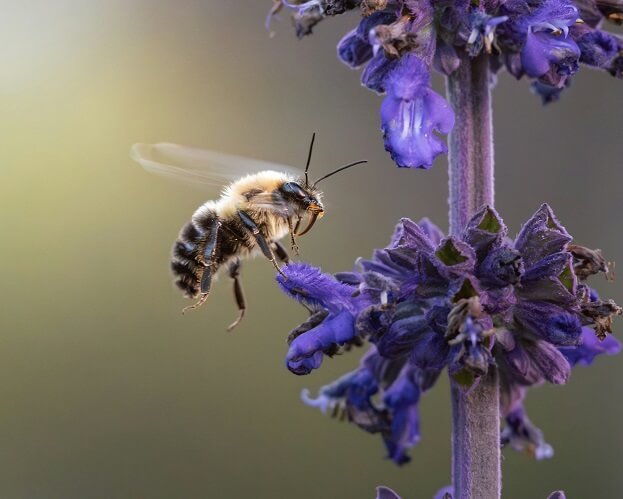 A loud buzz near the picnic table usually makes everyone freeze right in their tracks. Kids love watching a fuzzy yellow bee crawl deep inside a flower, even if they take a quick step back when it flies past.
Once your child knows what that tiny bug is actually doing in the garden, those nervous moments turn into pure curiosity. You can share these simple, true stories the next time you spot one outside together.
11 Interesting & Fun Bee Facts for Kids They Will Love to Know about
Every spoonful of sweet golden honey on your morning toast started inside a tiny flower. Somehow, an insect the size of a jellybean gathers that flower juice and turns it into food without a kitchen.
Bees also have some of the coolest jobs in nature, from wiggling their bodies like dancers to building wax homes straight from their own bellies.
Now let us take a look at those fun bee facts!
1. Bees Flap Their Wings 230 Times in a Single Second
Try flapping your arms up and down as fast as you can for one second. You might manage three or four flaps before your shoulders get exhausted!
A honeybee has two pairs of wings hooked together by microscopic teeth called hamuli, and it beats those wings at a blistering 230 times every single second! Scientists at Caltech discovered that bees have special asynchronous flight muscles that vibrate automatically, keeping that super-fast 230-beat rhythm whether flying light or carrying heavy pollen.
That lightning-fast wing speed displaces air so rapidly that it produces the iconic buzzing sound you hear whenever a bee whizzes past your ear.
2. A Worker Honeybee Is Only Half an Inch Long
Bees can seem intimidating when they buzz close to your picnic blanket, but they are actually remarkably tiny creatures.
A standard worker honeybee measures about 0.5 inches (13 millimeters) long, which is about the size of a single sweet jellybean. Inside the hive, the mother queen bee grows much larger, reaching 0.8 inches (20 millimeters) long!
Across the wider bee world, sizes get even wilder: the smallest bee on Earth (the fairy bee) measures just 0.08 inches (2 millimeters) long (smaller than a grain of rice), while the world’s largest bee (Wallace’s giant bee) has a wingspan of 2.5 inches and is as big as an adult’s thumb!
3. Honeybees Have a Special “Honey Stomach” for Flower Nectar
When a honeybee lands on a fragrant flower blossom, it unfurls a long, straw-like tongue called a proboscis to drink sweet floral nectar.
Instead of digesting that sugary juice, the bee stores it inside a specialized secondary belly called a honey stomach (or crop). A one-way valve keeps the nectar completely separate from her regular stomach so she can fly it safely back to the hive!
Back home, house bees add natural enzymes that break complex sugars down into simple sugars, spread the liquid across honeycomb cells, and fan their wings like tiny ceiling fans to evaporate the water down to less than 18 percent. Because finished honey is so pure and moisture-free, it never spoils: archaeologists have found 3,000-year-old pots of honey in Egyptian tombs that are still perfectly edible!
4. Baby Bees Are Called Grubs and Eat Royal Jelly
Before a bee ever grows gossamer wings or black-and-gold stripes, it undergoes a complete four-stage metamorphosis (egg, larva, pupa, adult), just like a caterpillar transforming into a butterfly!
After three days, an egg hatches into a tiny, legless white grub called a larva. Nurse bees feed every newborn baby a protein-rich superfood called royal jelly, secreted from glands in the workers’ heads.
Here is the magical secret: all female baby bees are born identical! Worker grubs are switched to regular honey and pollen after three days and take 21 days to grow up. But if workers keep feeding a baby grub an exclusive diet of pure royal jelly, special genes activate that transform her into a fertile, long-lived queen bee in just 16 days!
5. Honeybees Huddle in a Giant Group Hug All Winter
You never see bees buzzing around snowmen in the winter, but they do not migrate south or hibernate underground!
When outdoor temperatures drop below 50 degrees Fahrenheit (10 degrees Celsius), the bees gather tightly inside the hive to form a winter cluster. They pack together like a giant, coordinated group hug, flexing their flight muscles to shiver and generate body heat without moving their wings. Even in sub-zero blizzards, this shivering cluster keeps the center around the queen at a toasty 90 to 95 degrees Fahrenheit (32 to 35 degrees Celsius)!
To fuel their shivering all winter, bees feed on the rich honey stores they spent the sunny summer collecting, with specialized winter worker bees living up to 6 months to protect the queen until spring.
6. A Bee Has Five Eyes on Its Head
You use two eyes to navigate the playground, so it is easy to assume a bee sees the world through two eyes as well. In reality, a bee has five separate eyes on its head!
It has two large compound eyes on the sides of its face, each made of thousands of tiny hexagonal lenses that detect rapid motion and polarized sunlight, much like the multifaceted eyes of dragonflies. Sitting in a triangle right on top of its forehead are three simple eyes called ocelli, which act like light meters to help the bee orient to the horizon while flying.
While bees cannot see the color red, their vision extends into ultraviolet light. Flowers have invisible ultraviolet ‘nectar guides’ that glow like airport runway lights, guiding bees straight to the sweet center!
7. Honeybees Do a Figure-Eight “Waggle Dance” to Talk
Honeybees cannot speak words or send text messages, yet they have one of the most sophisticated communication languages in the animal kingdom!
When a scout bee discovers a bountiful flower meadow, she flies home to the dark hive and performs the famous waggle dance across the honeycomb. She struts forward in a straight line while shaking her abdomen vigorously from side to side, then circles back in a figure-eight pattern.
This dance is a living GPS map: the angle of her waggle line relative to gravity tells her sisters the exact direction toward the flowers relative to the sun! The length of the waggle tells them the precise distance (one second of waggling equals about 3,000 feet), a discovery so incredible it earned scientist Karl von Frisch a Nobel Prize!
8. Worker Bees Make Wax From Their Own Bellies to Build Home
When you build a fort out of toy bricks, you need to buy blocks from a store first. Honeybees literally manufacture their own building materials right out of their own bellies!
Worker bees have four pairs of special wax glands on the underside of their abdomen. These glands excrete clear liquid wax that hardens into thin flakes when exposed to air, which bees chew with their mandibles to soften like warm modeling clay.
Making wax takes immense energy: bees must eat about 8 pounds of honey to produce a single pound of beeswax! To save wax, bees build their honeycomb rooms in perfect hexagons (six-sided shapes). Mathematicians proved that hexagons hold the maximum amount of honey using the absolute minimum amount of wax, with honeycomb walls just 0.07 millimeters thick supporting 25 times their own weight!
9. One Queen Bee Lives With Up to 80,000 Helpers in a Single Hive
A honeybee hive is not just a house for bugs: it is an organized metropolis of up to 60,000 to 80,000 bees working as a single superorganism!
Just like in colonies of their close social cousins, the ants, every single worker bee in the hive is female (a girl)! Sisters progress through jobs as they age: starting as nursery cleaners, graduating to nurse bees and wax architects, and finally becoming courageous outdoor foragers.
At the heart of the colony lives the queen bee, who can live up to 5 years. During spring and summer, she lays up to 2,000 eggs every single day (more than her entire body weight in eggs!), releasing calming queen pheromones that keep tens of thousands of sisters working in peace.
10. Boy Honeybees Do Not Have Stingers and Cannot Sting You
Many children freeze in fear when a bee buzzes nearby because they worry every bee is armed and ready to sting. That is actually a common misunderstanding!
Male honeybees (called drones) have no stingers at all and cannot sting you! A stinger is an ovipositor (a modified egg-laying organ), which means only female bees have them. Even female worker bees only sting as an absolute last resort to protect their colony.
Because a worker honeybee’s stinger has tiny backwards-pointing barbs, it lodges in thick human skin when used, causing the bee to perish after stinging once. There are also hundreds of tropical stingless bee species that produce sweet honey without having any functional stinger at all!
11. Bees Help Grow More Than 130 Fruits, Nuts, and Vegetables
Bees do far more than provide delicious golden honey for morning toast: they are the most important agricultural pollinators on Earth!
As a foraging bee crawls inside blossoms, millions of yellow pollen grains cling to the fuzzy branched hairs on her body. She grooms the pollen into specialized concave baskets on her hind legs called corbiculae to carry back to the hive, but she also transfers pollen between flowers, allowing plants to produce seeds and fruit.
Scientists estimate that bees pollinate one out of every three bites of food we eat, supporting over 130 essential crops! Every time you enjoy crisp apples, like the orchards planted in stories of Johnny Appleseed, as well as strawberries, melons, blueberries, and crunchy almonds, you can thank a busy bee for making that delicious snack possible.
Frequently Asked Questions (FAQs)
1. What do bees eat?
Bees drink carbohydrate-rich liquid nectar from flowers for flying energy and collect protein-packed pollen dust to nourish growing baby larvae inside the hive.
2. What is a baby bee called?
A baby bee that hatches from an egg is called a larva (or grub). It feeds on royal jelly and bee bread before spinning a silk cocoon to transform as a pupa into an adult bee.
3. How many eyes does a bee have?
A bee has five eyes in total: two large compound eyes on the sides of its head for motion and ultraviolet vision, and three tiny simple eyes (ocelli) on top of its head for flight orientation.
4. Do all bees live in big hives?
No, over 90 percent of the world’s 20,000 bee species are solitary bees (such as mason bees and leafcutter bees) that live individually in hollow twigs, wood, or soil tunnels without a queen or hive.
5. How fast can a honeybee fly?
An unladen worker honeybee typically flies at speeds of 15 to 20 miles per hour (24 to 32 km/h), slowing down to around 12 mph when carrying heavy pollen and nectar payloads.
6. How long do honeybees live?
Hardworking summer worker bees live about 5 to 6 weeks, while specialized winter worker bees can live for 4 to 6 months. In contrast, a healthy queen bee can live for 2 to 5 years.
Next time you and your child see a fuzzy bee visiting a bright yellow flower, take a moment to watch its back legs and busy wings. You might spot shiny golden pollen packed onto its legs as it gathers food for its hive family.
That was it, folks! Hope you and your little one enjoyed these amazing facts about bees.


