11 Amazing Camel Facts for Kids [UPDATED]
 “Mom, is there water sloshing around inside that giant bump on the camel’s back?” That is usually the very first question your kid asks when spotting a tall, long-legged camel at the zoo or in a storybook.
With their giant humps, double eyelashes, and chewy sideways grins, camels look like they were built from a box of spare animal parts. Every single part of a camel’s body has an ingenious job that helps it survive in burning hot sand and freezing desert winds. Here are the coolest scientifically verified facts about these legendary desert travelers that you can share with your young explorer today.
11 Interesting & Fun Camel Facts for Kids They Will Love to Know about
Most mammals would quickly suffer heat exhaustion and dehydration in a blistering, waterless desert. Camels, however, carry a magnificent toolkit of evolutionary superpowers that allow them to munch on sharp desert thorns, navigate blinding sandstorms, and travel for weeks without taking a single sip of water.
Even better, their deep, rumbling voices once helped create the iconic sound effects for a beloved space movie you and your family probably know by heart.
Now let us journey across the dunes and explore these incredible camel facts!
1. Camels Store Fat in Their Humps, Not Water
You have probably heard people say that a camel carries an internal water canteen inside the bump on its back. While that sounds like a handy invention for long desert treks, it is actually a famous myth!
A camel’s hump is packed with pure stored fat, weighing up to 80 pounds (36 kilograms) in a healthy adult. Unlike mammals explored in our fascinating polar bear facts that keep a blanket of insulating blubber wrapped evenly around their entire bodies, camels concentrate almost all their fat in one spot on their backs. This clever design allows heat to escape quickly from the rest of their body, keeping them cool under scorching desert sun.
When food is scarce across the dunes, the camel’s body breaks down this dense hump fat for sustained energy. As the fat reserves are used up, the hump shrinks, turns soft, and droops limp over to one side until the camel enjoys big meals again!
2. Unique Oval Blood Cells Allow Thirsty Camels to Chug 30 Gallons in Minutes
Finding an oasis in a dry desert takes days of patient walking. Because water is so scarce, a camel can easily travel for a week without drinking in blistering summer heat, and survive up to several months during cooler seasons by grazing on moisture-rich desert plants.
When a thirsty camel finally reaches water, it drinks faster than almost any other land creature. It can swallow over 25 to 30 gallons (100 to 115 liters) in just 10 minutes, and drink up to 40 gallons (150 liters) in one single session! That is equivalent to drinking 30 to 40 giant family-sized milk jugs all at once.
If any other mammal drank that much water that fast, its red blood cells would burst from sudden osmotic pressure. Camels are the only mammals on Earth with oval-shaped red blood cells! These flexible, football-shaped cells can swell up to 240 percent of their original size without rupturing, flowing smoothly even when the camel’s blood gets thick during severe dehydration.
3. A Grown-Up Camel Weighs as Much as Two Grand Pianos
Looking at a photo in a book, it is hard to tell just how colossal a camel really is. If you stood right beside a full-grown camel, you would have to tilt your head all the way back to see the crown of its hump!
Adult dromedary camels stand 6.6 to 7 feet (2.0 to 2.1 meters) tall at the hump and stretch roughly 10 feet (3 meters) in length. Full-grown males weigh between 900 and 1,400 pounds (400 to 650 kilograms), while two-humped Bactrian camels can weigh up to an astounding 1,800 to 2,200 pounds (800 to 1,000 kilograms).
Standing 7 feet tall makes an adult camel taller than almost every adult you know, reaching straight to the top of your front doorway. Weighing 1,400 to 1,800 pounds means a big camel weighs just as much as two heavy grand pianos put together!
4. Tough Mouth Papillae Let Camels Feast on Needle-Sharp Thorns
Most animals would end up with painful cuts and bleeding mouths if they tried to chew on prickly desert bushes. Out across arid sands, tough thorny acacia branches, dry scrub, and salty bushes are often the only food available.
To safely harvest these prickly snacks, a camel has a split upper lip that moves in two independent halves like a pair of dexterous fingers. Even more remarkably, the inside of a camel’s mouth is lined with hundreds of tough, raised cones called keratinized oral papillae. These leathery bumps point backward, sliding sharp spines harmlessly down the throat without puncturing the gums or tongue!
Camels are pseudoruminants that chew their cud much like the herbivores featured in our incredible moose facts. With a specialized three-chambered stomach, camels regurgitate partially digested food to chew it a second time, wringing every drop of nutrition from woody desert shrubs.
5. Built-In Sand Goggles and Moisture-Trapping Noses Defeat Sandstorms
Getting even a single speck of sand blown into your eye on a windy beach can sting terribly. Imagine walking across a desert when ferocious winds whip up a towering wall of flying sand!
Camels possess a three-layer defense system against flying dust. First, they have double rows of long, interlocking curly eyelashes that act like sun visors and sand fences. Second, they have a clear third eyelid (nictitating membrane) that slides horizontally across the eyeball like a built-in windshield wiper, cleaning away dust while still letting the camel see where it is walking.
Third, a camel can squeeze its nostrils completely shut into tight slits so no sand blows up its nose. Inside the nasal passage, scroll-shaped bones called nasal turbinates trap water vapor from every exhaled breath, condensing moisture so the camel reabsorbs it instead of losing precious water to the dry desert air!
6. Camels Tolerate 106-Degree Body Heat Before Releasing a Single Drop of Sweat
When children run around outside on hot afternoons, their bodies begin sweating immediately to keep cool, as detailed in our guide to fun summer facts for kids. In a scorching desert, however, sweating continuously would cause an animal to run out of water in hours.
To guard every droplet of moisture, camels practice a biological trick called adaptive heterothermy. Instead of keeping a steady 98.6-degree body temperature, a camel lets its core temperature fluctuate naturally. It cools down to 93 degrees Fahrenheit (34 degrees Celsius) during chilly desert nights, and slowly warms up to 106 degrees Fahrenheit (41 degrees Celsius) under the midday sun before it starts sweating at all!
By delaying sweating, camels save over a gallon of vital water every single day, matching the water-saving mastery shown in our desert tortoise facts. When resting on sand that reaches 150 degrees Fahrenheit, tough leathery pads on their chest and knees hold their belly off the ground, allowing cooling breezes to circulate beneath them.
7. A Camel’s Grumbly Roar Helped Voice Chewbacca in Star Wars
You might picture camels trudging silently across quiet sand dunes, but they are actually vocal animals with a colorful range of sounds!
Camels communicate through low grumbles, barks, loud bellows, and deep, guttural roars. In fact, when legendary Hollywood sound designer Ben Burtt was creating the iconic voice of Chewbacca the Wookiee for the Star Wars movies, he blended recordings of black bears, badgers, and the raspy, bubbling roar of an irritated camel!
Camels also have affectionate ways to speak with family members. Mother camels and their baby calves gently hum to one another, and camel friends greet each other by warmly blowing air directly into each other’s faces to recognize their familiar scent.
8. A Newborn Camel Calf Can Stand and Walk Within Hours of Birth
Human babies spend about a full year crawling and building balance before taking their very first wobbly steps. Out in the open desert, where predators and harsh weather are constant threats, a newborn camel must get on its feet immediately.
Mother camels carry their developing young for a long gestation period of 12 to 14 months before giving birth to a single calf. Within just 30 to 60 minutes after birth, the precocial calf wobbles onto its long legs and stands up, ready to walk beside its mother across the desert on its very first day!
Standing about 3 feet (1 meter) tall on day one, a newborn calf is about as tall as an average kitchen counter. Calves are born without a hard hump, possessing only a soft skin peak that fills with fat once they begin eating solid desert greens. The calf nurses on nutrient-rich milk for 12 to 18 months, growing steadily until reaching adult maturity around 7 years of age.
9. You Can Remember Dromedary and Bactrian Camels with a Simple Letter Trick
Not all camels look the same or share the same home territory. The world has two primary domesticated camel varieties, distinguished by their humps and geographic adaptations.
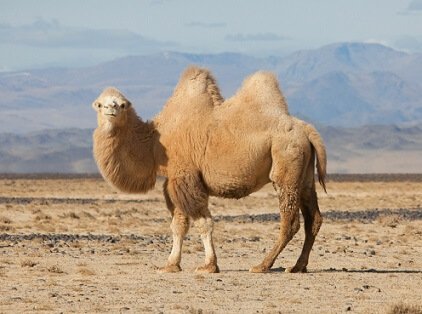
The dromedary (Arabian) camel has one hump and makes up roughly 94 percent of the global camel population, thriving in the hot deserts of North Africa, the Middle East, and Australia. The Bactrian camel has two humps, sporting a dense, shaggy wool coat that protects it in the freezing minus-40-degree winter winds of Central Asia and Mongolia.
You can remember which is which with a simple alphabet trick that works every time. Picture a capital letter D lying flat on its back: it has one bump for Dromedary. Now picture a capital letter B on its back: it has two bumps for Bactrian!
10. Puffed Cheeks and Gurgles Warn That an Annoyed Camel Is Ready to Spit
Camels are generally calm, hard-working herd animals led by a dominant male. However, when a camel feels cornered, frightened, or irritated, it has a famous defensive weapon that sends intruders running!
When a camel decides to spit, it is not releasing normal mouth saliva. Instead, the camel contracts its stomach muscles and brings up regurgitated digestive cud, shooting a foul-smelling green mixture of half-digested vegetation and stomach acids directly at its target!
Fortunately, an annoyed camel gives unmistakable warning signals before launching this smelly surprise. It flattens its ears back against its head, grinds its teeth, and puffs out its cheeks with loud gurgling noises. If you ever see a camel puffing its cheeks, step back immediately!
11. These Two-Toed “Ships of the Desert” Can Sprint at 40 Miles per Hour
For over 3,000 years, desert travelers have celebrated camels as the ultimate “ships of the desert.” Fascinatingly, fossil discoveries show that the ancient ancestors of modern camels actually evolved in North America over 40 million years ago before migrating across the ancient Bering land bridge into Asia!
Instead of hard, pointed hooves like horses, each camel foot ends in two large toes resting upon a broad, spongy cushion of elastic fat and tough connective tissue. This wide pad spreads out like a snowshoe with every step, preventing the heavy camel from sinking into soft sand dunes.
When moving, camels employ a unique pacing gait, swinging both legs on the right side together, then both legs on the left side, producing a soothing rocking motion like a ship riding ocean waves. While they can carry 400 pounds for 30 miles a day at an easy walking pace, camels can accelerate into sudden high-speed sprints reaching 40 miles per hour (65 kilometers per hour), rivaling the burst speed seen in our blistering cheetah facts!
Frequently Asked Questions (FAQs)
Do camels really keep water in their humps?
No, a camel’s hump stores up to 80 pounds of dense fat, which provides energy when food is scarce. Camels conserve water through oval red blood cells, moisture-trapping nasal passages, and an adaptive body temperature that prevents sweating until 106 degrees Fahrenheit.
What is a baby camel called?
A baby camel is called a calf. Newborn calves stand 3 feet tall and can stand and walk beside their mothers within hours of birth. They are born without a firm hump, which develops as they grow and store fat.
What do camels eat in the desert?
Camels are herbivorous pseudoruminants that eat thorny shrubs, dry grasses, acacia branches, and salty desert bushes. Tough, cone-shaped keratin papillae inside their cheeks protect their mouths from being poked by sharp thorns.
How fast can a camel run?
A camel can sustain an easy traveling trot of 15 to 25 miles per hour for long distances, and can sprint in rapid bursts up to 40 miles per hour (65 kilometers per hour), matching the speed of a galloping racehorse.
How can you tell a dromedary camel from a Bactrian camel?
Dromedary camels have one hump (like a capital letter D on its back) and short fur suited for hot deserts. Bactrian camels have two humps (like a capital letter B on its back) and grow long, shaggy coats to survive freezing winters in Central Asia.
How long do camels live?
In healthy wild herds and domestic care, camels typically live between 35 and 40 years, with some well-cared-for camels reaching 50 years of age.
Next time you and your child see a camel at the zoo, check to see whether it is a one-humped dromedary or a two-humped Bactrian, look for its broad sandshoe feet, and admire how every inch of its body is designed for desert survival!
That was it, folks! Hope you and your little one enjoyed these amazing facts about camels.