
11 Surprising Cheetah Facts for Kids [UPDATED]
 Your family car takes a few seconds just to pull out of the driveway and roll down the street. In that same tiny moment, a wild cheetah is already zooming faster than traffic on the highway.
When your kid spots this yellow cat in an animal book, the big questions start popping up right away. How do such skinny legs move so fast, and why does a big wild cat chirp like a backyard bird?
11 Interesting & Fun Cheetah Facts for Kids They Will Love to Know about
Most big cats use heavy muscles and big teeth to wrestle their dinner to the ground. Cheetahs are built completely differently, trading heavy muscles for a sleek body made purely for speed.
From built-in soccer cleats on their paws to fluffy baby manes, every single part of a cheetah has a special job to do.
Now let us take a look at those fun cheetah facts!
1. Cheetahs Can Speed Up Faster Than Most Family Cars
When you ride in a car merging onto the highway, you can feel the engine push you back in your seat as the car builds up speed. Even then, most everyday family cars need six to eight seconds to reach 60 miles per hour.
A wild cheetah is the fastest land mammal on Earth and can accelerate from a dead stop to 60 miles per hour (96 kilometers per hour) in under 3 seconds, out-accelerating most sports cars! At full sprint across flat ground, a cheetah can reach blinding top speeds of 60 to 70 miles per hour (96 to 112 km/h).
While the soaring peregrine falcon reaches higher speeds by plunging downward in a gravity-assisted dive, the cheetah rules the ground under pure leg power. Its flexible spine bends and uncoils like a giant steel spring, allowing the cheetah to cover 22 to 25 feet in a single bound and spend more than half of its sprint flying through the air with all four paws off the ground!
2. A Full-Grown Cheetah Weighs About the Same as a Big Dog
If an animal is too heavy, carrying all that extra bulk makes explosive sprinting impossible. That is why cheetahs have evolved lightweight, slender skeletons that look completely different from heavy-muscled lions or tigers.
An adult cheetah weighs only about 75 to 125 pounds (34 to 57 kilograms), with the largest males reaching up to 143 pounds. Its slender body measures about 4 to 5 feet long, standing roughly 2.5 to 3 feet tall at the shoulder, balanced by a long, muscular tail.
That means an adult cheetah weighs about the same as a large wild gray wolf or a big family dog! Every ounce of that lightweight frame is designed for speed, featuring enlarged lungs, wide nasal passages, and an oversized heart that pumps oxygen to its muscles at record-breaking rates.
3. Cheetahs Climb Termite Mounds to Spot Their Favorite Food
Unlike leopards that ambush prey from dense bushes or lions that hunt by stealth at night, cheetahs hunt by daylight using phenomenal vision. Before launching a high-speed chase, a cheetah needs a clear view of the open African plains.
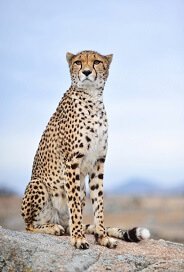
To scan the flat savannah, a cheetah climbs atop elevated vantage points like tall termite mounds, fallen acacia logs, or granite boulders. From these perches, it watches for herds of Thomson’s gazelles, impalas, warthogs, and troops of baboons foraging across the grass.
Cheetahs have a specialized horizontal visual streak across their retinas that gives them high-resolution panoramic vision, allowing them to spot moving animals over 3 miles away! Once it selects a target, the cheetah stalks slowly through tall grass until it is within 60 to 100 yards before detonating into an explosive sprint.
4. Baby Cheetah Cubs Wear a Fluffy Gray Mane to Stay Hidden
Baby cheetahs are called cubs, and a mother typically gives birth to 3 to 6 cubs in a hidden lair among rocks or tall marsh grass. Newborn cubs are tiny and defenseless, weighing only 5 to 10 ounces (150 to 300 grams), which is about the weight of a small juice box.
Because dangerous predators like lions and hyenas hunt on the plains, cheetah cubs are born with an extraordinary defensive disguise: a thick, fuzzy mane of smoky-gray fur running down their neck and back called a mantle.
This fuzzy mantle serves two brilliant survival purposes: it helps the cubs blend seamlessly into dry grass shadows, and scientists believe it mimics the look of a ferocious honey badger! Most predators avoid tangled fights with fearless honey badgers, giving tiny cheetah cubs a clever cloak of protection until the mantle naturally sheds around three months of age.
5. Cheetahs Hunt in the Cool Morning and Rest in the Hot Afternoon
Most large African predators do their hunting under the cover of pitch-black darkness. For a slender, lightweight cheetah, hunting at night would mean competing with bigger, heavier predators that can easily overpower it.
To stay safe, cheetahs are diurnal (daytime) hunters, doing most of their hunting in the cool morning right after sunrise and in the late afternoon before sunset. Hunting during daylight allows cheetahs to make full use of their binocular vision while lions and leopards are sleeping in the shade.
To protect their eyes from the blinding tropical sun, cheetahs have iconic black “tear stripes” running from the inner corners of their eyes down to their mouth. These dark lines absorb bright sunlight, reducing glare just like the black greasepaint football players wear under their eyes!
6. Their Claws Stay Out Like Built-In Soccer Cleats
If you look at your family cat’s paws, its sharp claws tuck completely inside protective skin pockets until needed. If a cheetah had smooth, retractable paws, running at 60 miles per hour on dry dirt would make it skid and crash!
A cheetah is the only cat whose claws are semi-retractable, meaning they lack protective sheaths and stay permanently exposed. Just like the running claws of racing greyhounds, a cheetah’s blunt claws dig deep into the turf with every stride.
Paired with tough, pointed ridges on its paw pads, these exposed claws work exactly like athletic cleats on soccer shoes. They provide incredible traction, allowing a sprinting cheetah to brake suddenly, swerve around obstacles, and pull off 2-G lateral turns without losing its footing. The only claw that stays sharp and elevated is the dewclaw on the inside of its front leg, which the cheetah uses like a grappling hook to trip prey at top speed!
7. Cheetahs Cannot Roar, So They Chirp Like Birds Instead
When you think of a mighty African cat, you probably picture a thunderous roar that reverberates across the savannah. But if you listen to a cheetah talking, you will hear something totally unexpected!
Instead of roaring, cheetahs communicate with high-pitched chirps that sound remarkably like little birds! A mother cheetah uses loud chirps to call her scattered cubs, and these bird-like calls are so piercing they can carry across open grasslands for over 1 mile.
The reason cheetahs cannot roar comes down to anatomy: big cats like lions and tigers have a flexible cartilage ligament in their throats that allows deep roaring, but prevents continuous purring. Cheetahs have a rigid, solid hyoid bone in their voice box. This prevents them from roaring, but allows them to produce rich, rhythmic purrs while breathing both in and out, just like a giant house cat!
8. Most Wild Cheetahs Live in Wide-Open Grasslands in Africa
A sprinting athlete needs wide-open tracks without fences or thick forests to reach top speeds. Cheetahs require vast, open savannahs, scrub forests, and semi-deserts where they can sprint without crashing into dense trees.
Today, scientists estimate that approximately 7,000 wild cheetahs survive in the wild, with the vast majority living in eastern and southern Africa in countries like Namibia, Botswana, Kenya, and Tanzania. A tiny, critically endangered population of Asiatic cheetahs also clings to survival in the arid central plateau of Iran.
In dry savannah habitats, cheetahs are masters of water conservation. They rarely need to visit water holes, obtaining nearly all the hydration they need directly from the moisture in the fresh meat of their prey!
9. Cheetah Brothers Team Up for Life in a Group Called a Coalition
Most wild cats in the world are solitary hermits that guard their territories alone. Female cheetahs follow this rule, wandering across vast grasslands by themselves except when caring for their cubs for about 18 months.
Male cheetahs, however, do something unique in the cat world: brothers team up for life!
When young males leave their mother, two to four brothers stick together to form a permanent brotherhood called a coalition. By patrolling, hunting, and defending territory together, coalition brothers hold prime hunting grounds three times longer than solitary males, grooming each other’s fur and remaining loyal companions for their entire lives.
10. Myth Busted: Cheetahs Cannot Run Forever and Miss Half Their Chases
Because cheetahs are the fastest land animals in the world, movies often make it look like they can run forever and catch everything in sight. In real life, sprinting at highway speeds pushes the body to its extreme physical limits!
A cheetah’s supersonic sprint rarely lasts longer than 20 to 30 seconds, covering about 200 to 300 yards (roughly three football fields). Because agile gazelles twist and dodge at high speeds, cheetahs succeed on about 40 to 50 percent of their hunts, which is still double the success rate of a lion!
Contrary to a common myth that cheetahs quit because they overheat, scientists discovered their muscles simply exhaust their emergency fuel. Sprinting without oxygen builds up intense lactic acid, forcing the cheetah to lie down and pant heavily for 20 to 30 minutes, catching its breath before larger scavengers arrive.
11. The Word “Cheetah” Comes From an Ancient Word for “Spotted”
If you look closely at a cheetah’s golden coat, you will see round, solid black polka dots instead of the hollow rose-shaped rings (rosettes) found on leopards. Those distinct markings gave the cat its name thousands of years ago!
The word “cheetah” comes from the ancient Indian Sanskrit word chitraka, which means “speckled” or “the spotted one”. Every cheetah sports between 2,000 and 3,000 solid black spots on its body, with four to six dark rings circling the tip of its tail.
Just like human fingerprints, every cheetah’s spot and tail-ring pattern is completely unique! In addition, its long, muscular tail acts like a boat rudder in the air, swinging sharply sideways during high-speed chases to counterbalance tight turns so the cheetah never spins out!
Frequently Asked Questions (FAQs)
How fast can a cheetah run?
A cheetah can sprint at top speeds of 60 to 70 miles per hour (96 to 112 km/h) in short bursts and can accelerate from 0 to 60 mph in under 3 seconds.
What do cheetahs eat in the wild?
Cheetahs are strict carnivores that hunt small to medium-sized savannah herbivores, primarily Thomson’s gazelles, impalas, springboks, young warthogs, and wild hares.
What is a baby cheetah called?
A baby cheetah is called a cub. Newborn cubs are born with a fluffy silvery-gray mantle of fur along their backs that mimics a ferocious honey badger to deter predators.
Why do cheetahs have black lines on their faces?
The black “tear stripes” running from the eyes to the mouth absorb sunlight and eliminate glare, allowing cheetahs to spot distant prey clearly while hunting under bright daylight.
How much does an adult cheetah weigh?
Adult cheetahs weigh between 75 and 125 pounds (34 to 57 kg), keeping their bodies lightweight and aerodynamic for blistering acceleration.
How long do cheetahs live?
In the wild, cheetahs live an average of 8 to 12 years, though intense predator competition often shortens lifespans to around 7 or 8 years. In protected wildlife sanctuaries and accredited zoos, they regularly live for 14 to 17 years or more.
Next time you see a car speeding down the highway or hear a little bird chirping in a tree, your kid can tell everyone how both of those things remind them of a cheetah. From cleated paws to sun-blocking tear marks, this spotted sprinter is one of the coolest cats on Earth.
That was it, folks! Hope you and your little one enjoyed these amazing facts about cheetahs.


